
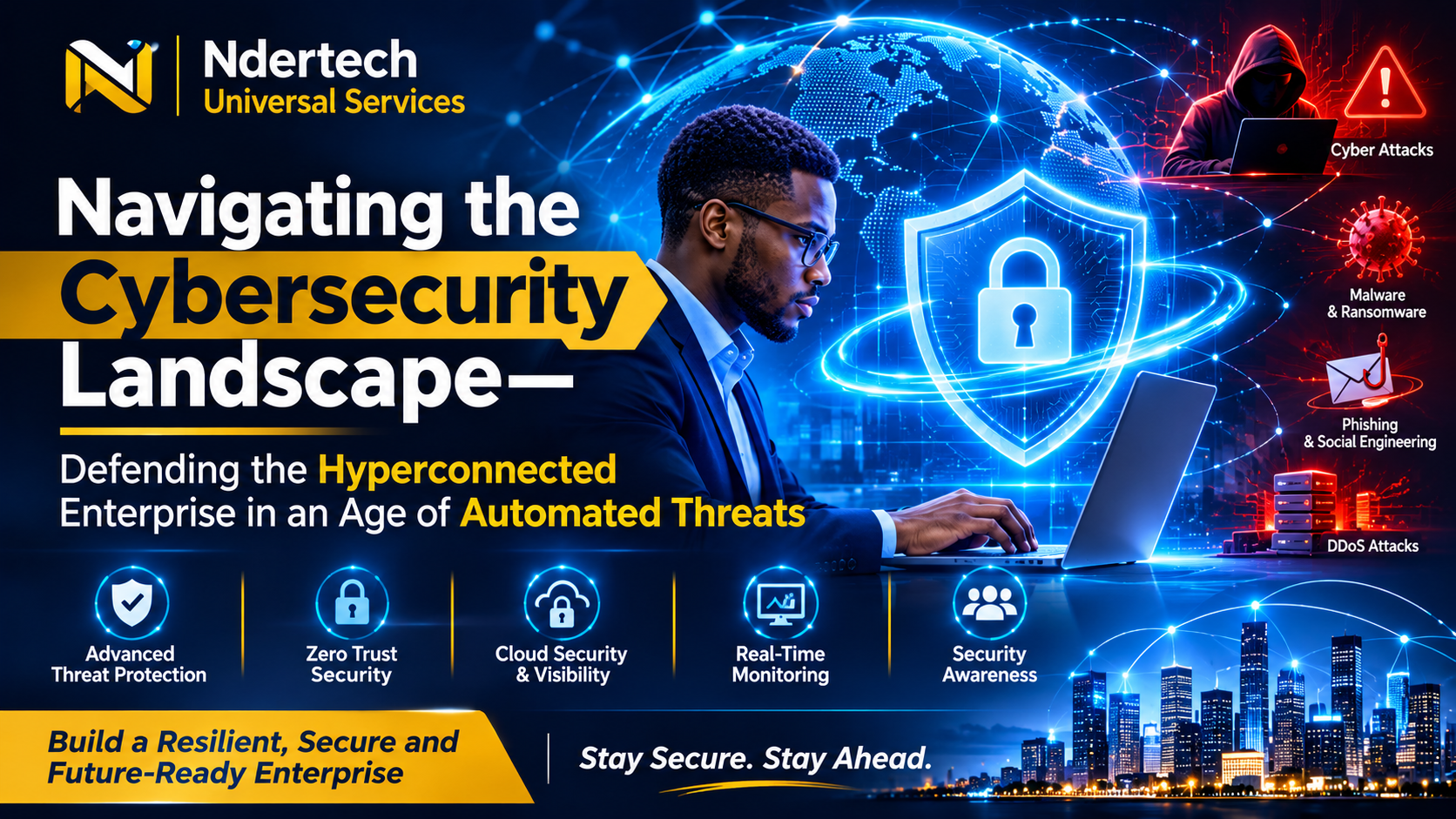
Navigating the Cybersecurity Landscape Defending the Hyperconnected Enterprise in an Age of Automated Threats
Introduction: The Escalating Cyber Threat Matrix
In an era defined by hyperconnectivity, cloud-native infrastructures, and ubiquitous artificial intelligence, the global cybersecurity paradigm has shifted decisively from a defensive posture of perimeter protection to a continuous state of active enterprise resilience. Rapid digital transformation has unlocked immense business efficiencies, but it has simultaneously expanded the digital attack surface exponentially. Modern enterprises no longer operate within traditional, closed corporate networks; instead, they manage sprawling, decentralized ecosystems comprising remote employees, third-party software-as-a-service (SaaS) vendors, Internet of Things (IoT) devices, and distributed multi-cloud workloads.
Simultaneously, malicious threat actors are aggressively weaponizing the exact same technologies that drive enterprise innovation. Cybercriminal syndicates, hacktivists, and state-sponsored APT (Advanced Persistent Threat) groups now deploy AI-driven phishing campaigns, automated vulnerability scanners, and sophisticated ransomware strains capable of autonomously mutating to evade legacy signature-based detection systems. Safeguarding organizational data, protecting intellectual property, and maintaining customer trust requires a fundamental modernization of enterprise cybersecurity frameworks, moving away from reactive firefighting toward predictive, intelligence-driven defense strategies.
The Double-Edged Sword of Artificial Intelligence in Cybersecurity
Artificial intelligence has become the primary battleground for both defenders and attackers. On the offensive side, generative AI has effectively democratized cybercrime. Threat actors with limited technical proficiency can now generate highly convincing, personalized spear-phishing messages at scale, entirely bypassing the traditional linguistic warning signs that once tipped off recipients. Automated exploitation tools can scan enterprise networks for misconfigurations and zero-day vulnerabilities significantly faster than human security teams can identify and patch them.
Conversely, enterprise security teams are leveraging advanced machine learning to turn the tide against these automated threats. Security Information and Event Management (SIEM) platforms powered by artificial intelligence can ingest millions of telemetry events per second, establishing precise baseline behavioral profiles for every user, application, and device across the network. When an anomaly occurs such as an administrator account accessing unusual data repositories at odd hours from an unrecognized IP address AI-driven orchestration tools can isolate the compromised endpoint within milliseconds, successfully neutralizing threats before lateral movement can occur.
Furthermore, recent breakthroughs in mechanistic interpretability research aimed at reverse-engineering how neural networks and large language models process decisions are helping security analysts audit AI models for hidden vulnerabilities and adversarial biases. By shedding light on the opaque "black box" of machine learning, security professionals ensure that automated defense systems remain reliable, transparent, and resilient against sophisticated adversarial manipulation.
Quantum Horizons: Preparing Enterprise Infrastructure for Post-Quantum Cryptography
While enterprises grapple with immediate, daily threats such as targeted ransomware and supply chain compromises, a much larger, longer-term existential challenge looms on the horizon: the impending advent of practical quantum computing. Current public-key cryptography algorithms (such as RSA and Elliptic Curve Cryptography), which secure virtually all global internet traffic, financial transactions, and encrypted enterprise data repositories, rely on mathematical factorization problems that are exceedingly difficult for classical computers to solve.
However, sufficiently powerful quantum computers operating with advanced error-corrected qubits will be capable of breaking these foundational encryption standards within hours, or even minutes. This looming vulnerability has already given rise to a malicious cyber espionage strategy known as "Harvest Now, Decrypt Later," where bad actors intercept and store encrypted enterprise data today, planning to decrypt it once quantum hardware matures.
In response, the IT and cybersecurity industries are aggressively developing, testing, and standardizing post-quantum cryptography (PQC). Lattice-based cryptography and other quantum-resistant mathematical algorithms are currently being integrated into modern security roadmaps. Forward-thinking Chief Information Security Officers (CISOs) are conducting comprehensive cryptographic inventories across their organizations, identifying every instance of legacy encryption, and establishing rigorous migration plans to transition enterprise systems to quantum-safe standards well before classical encryption becomes obsolete.
Building a Resilient Culture of Digital Trust and Human Vigilance
Advanced technology tools and robust encryption protocols alone cannot secure an enterprise; human behavior remains one of the most critical variables in the cybersecurity equation. Social engineering attacks continue to be the primary entry point for major corporate data breaches. Consequently, modern security strategies place heavy emphasis on cultivating a robust culture of digital trust and ongoing security awareness:
- Continuous, Contextual Training: Transitioning away from once-a-year compliance video modules toward dynamic, real-time phishing simulations and bite-sized training modules that adapt directly to employee roles and common risk behaviors.
- Zero-Trust Architecture (ZTA): Embracing the core security tenet of "never trust, always verify." Every user, device, and application request must be rigorously authenticated, authorized, and encrypted before gaining access to enterprise resources, regardless of operational location.
- Incident Response Preparedness: Recognizing that absolute prevention is impossible, elite organizations focus heavily on operational resilience. Regular tabletop exercises, automated backup verification, and clear cross-functional incident response playbooks ensure rapid containment and recovery if a breach occurs.
Ultimately, cybersecurity in the modern IT landscape is not a static product that can be purchased and installed; it is an ongoing, evolving discipline. Organizations that successfully integrate automated AI defense, prepare proactively for quantum shifts, and embed security consciousness into their corporate DNA will maintain a decisive competitive advantage in an increasingly hostile digital world.