
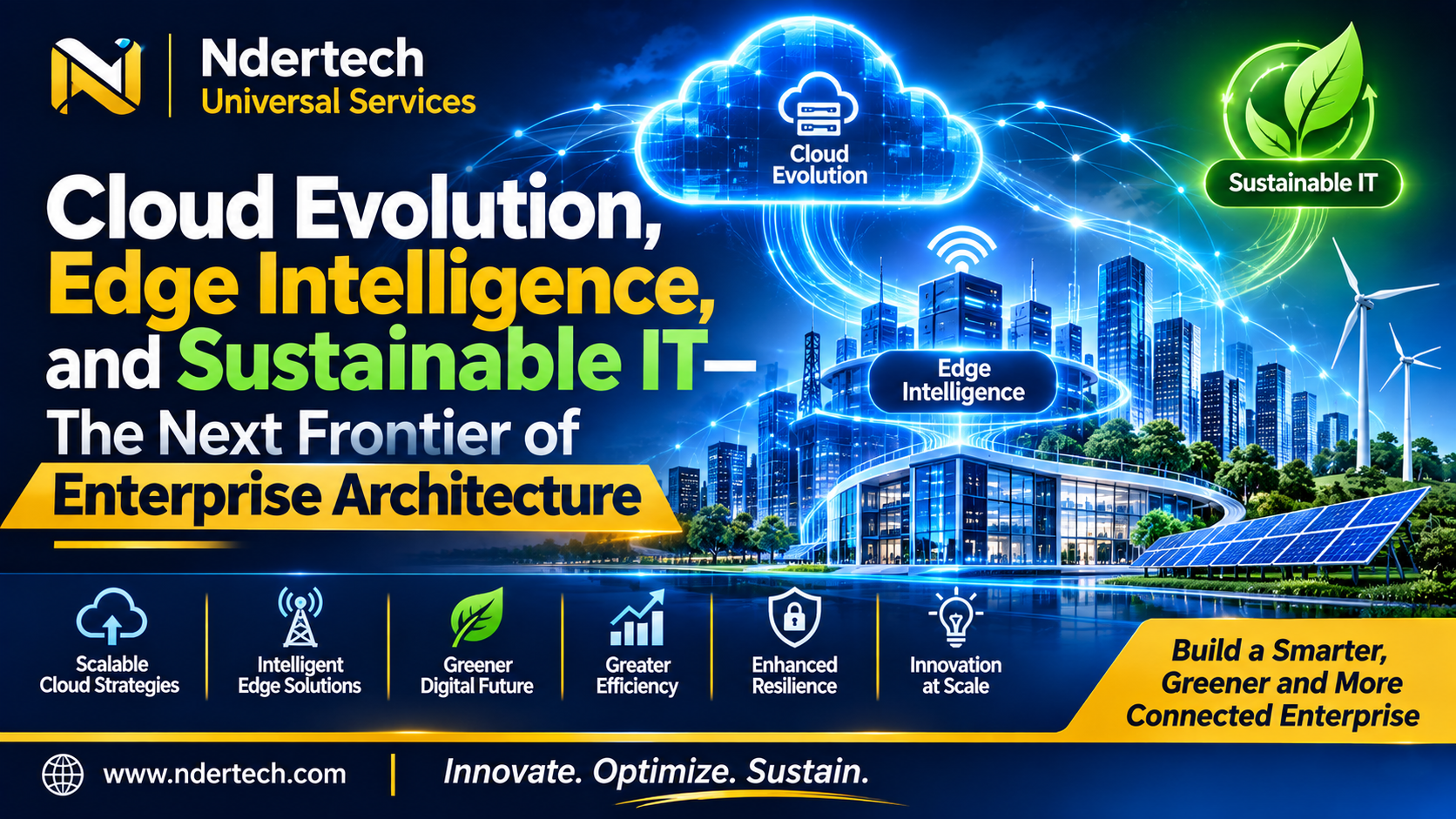
Cloud Evolution, Edge Intelligence, and Sustainable IT: The Next Frontier of Enterprise Architecture
Introduction: Beyond Traditional Centralized Cloud Computing
The architecture of enterprise information technology is currently experiencing a profound decentralization wave. For the past decade, the prevailing industry narrative was dominated by massive centralized cloud migrations, where companies shifted their physical data servers wholesale to hyperscale public cloud providers. While cloud computing remains the foundational technological backbone of the modern digital economy, the sheer volume of data generated by Internet of Things (IoT) devices, coupled with the stringent latency demands of real-time artificial intelligence, has exposed the inherent limitations of a purely centralized computing model.
Today, the IT sector is championing a sophisticated, distributed computing paradigm that seamlessly blends hyper-scalable public clouds, high-performance private data centers, localized edge computing nodes, and sustainable energy practices. This evolution is driven by an urgent organizational need for operational speed, cost optimization, data sovereignty, and environmental responsibility. As enterprises look toward the future, their technological infrastructure must be agile enough to process petabytes of real-time data while strictly adhering to global carbon-reduction mandates.
The Rise of Edge Computing and Intelligent IoT Integration
The exponential proliferation of smart sensors, autonomous industrial machinery, connected vehicles, and commercial IoT has created a data deluge that traditional cloud networks struggle to handle efficiently. Transmitting raw telemetry data from thousands of remote factory sensors across continents to a centralized cloud server introduces unacceptable network latency and consumes massive amounts of network bandwidth.
Enter edge intelligence the practice of processing data locally on smart devices or local micro-data centers situated right at the physical "edge" of the network. By utilizing localized computing power, organizations can analyze data instantaneously where it is generated. Key operational examples include:
- Predictive Maintenance: Industrial robots and manufacturing equipment equipped with edge AI can monitor their own mechanical vibrations and thermal outputs, predicting component failure and scheduling maintenance before costly downtime occurs.
- Autonomous Logistics: Fleet vehicles and warehouse robots process visual and spatial data locally to navigate dynamic physical environments safely without relying on a continuous, uninterrupted cloud connection.
- Smart Infrastructure: Commercial buildings utilize passive radiative cooling materials and IoT sensors to optimize energy consumption dynamically, minimizing utility waste and reducing operating expenses.
This edge-to-cloud continuum ensures that data is processed at the optimal location light-speed operational decisions happen at the edge, while heavy analytics, model training, and long-term archival storage are routed to the central cloud.
The Green Data Center: Sustainability as a Core IT Imperative
As artificial intelligence models scale dramatically in size, parameter count, and computational complexity, the global energy consumption of IT infrastructure has skyrocketed. Modern data centers demand unprecedented amounts of electrical power, putting immense pressure on local power grids and corporate carbon reduction targets. Consequently, sustainability has evolved from a public relations footnote into a core engineering requirement in the IT industry.
Technology leaders are actively reimagining how data centers are powered, cooled, and operated:
- Advanced Cooling Technologies: Transitioning away from traditional air-conditioning systems which consume vast amounts of electricity toward liquid cooling and immersion cooling technologies that dissipate heat from high-density AI servers far more efficiently.
- Renewable Energy Integration: Tech giants are partnering directly with nuclear, wind, and solar energy providers, building dedicated microgrids to power massive AI training clusters.
- Everything-to-Grid Energy Solutions: Innovative programs are beginning to tap into idle enterprise energy assets, such as electric vehicle fleets and commercial backup batteries, feeding stored energy back into public grids during peak demand hours.
Furthermore, software engineering practices are shifting toward green coding optimizing software algorithms to consume fewer CPU cycles and less memory, thereby reducing the carbon footprint of digital execution at scale.
Strategic Imperatives for the Modern CIO
For Chief Information Officers and IT engineering leaders, navigating this complex technological renaissance requires a balanced, strategic approach. The race to adopt emerging tools must be matched by rigorous architectural discipline. Key action items for IT executives include:
- Auditing Infrastructure Agility: Ensuring that enterprise architectures are flexible enough to support hybrid cloud, on-premises private infrastructure, and edge nodes seamlessly without creating isolated data silos.
- Prioritizing Energy Efficiency: Factoring energy consumption, carbon footprints, and sustainable procurement policies into every hardware and software purchasing decision.
- Fostering Continuous Upskilling: Investing in internal training programs to ensure engineering teams are well-versed in modern cloud-native development, edge deployment, and sustainable IT practices.
The future of information technology belongs to organizations that view infrastructure not merely as a cost center, but as a dynamic, intelligent, and sustainable engine for continuous innovation. By harmonizing edge intelligence, flexible cloud deployment, and environmental stewardship, the IT industry is laying the groundwork for a highly resilient digital society.