
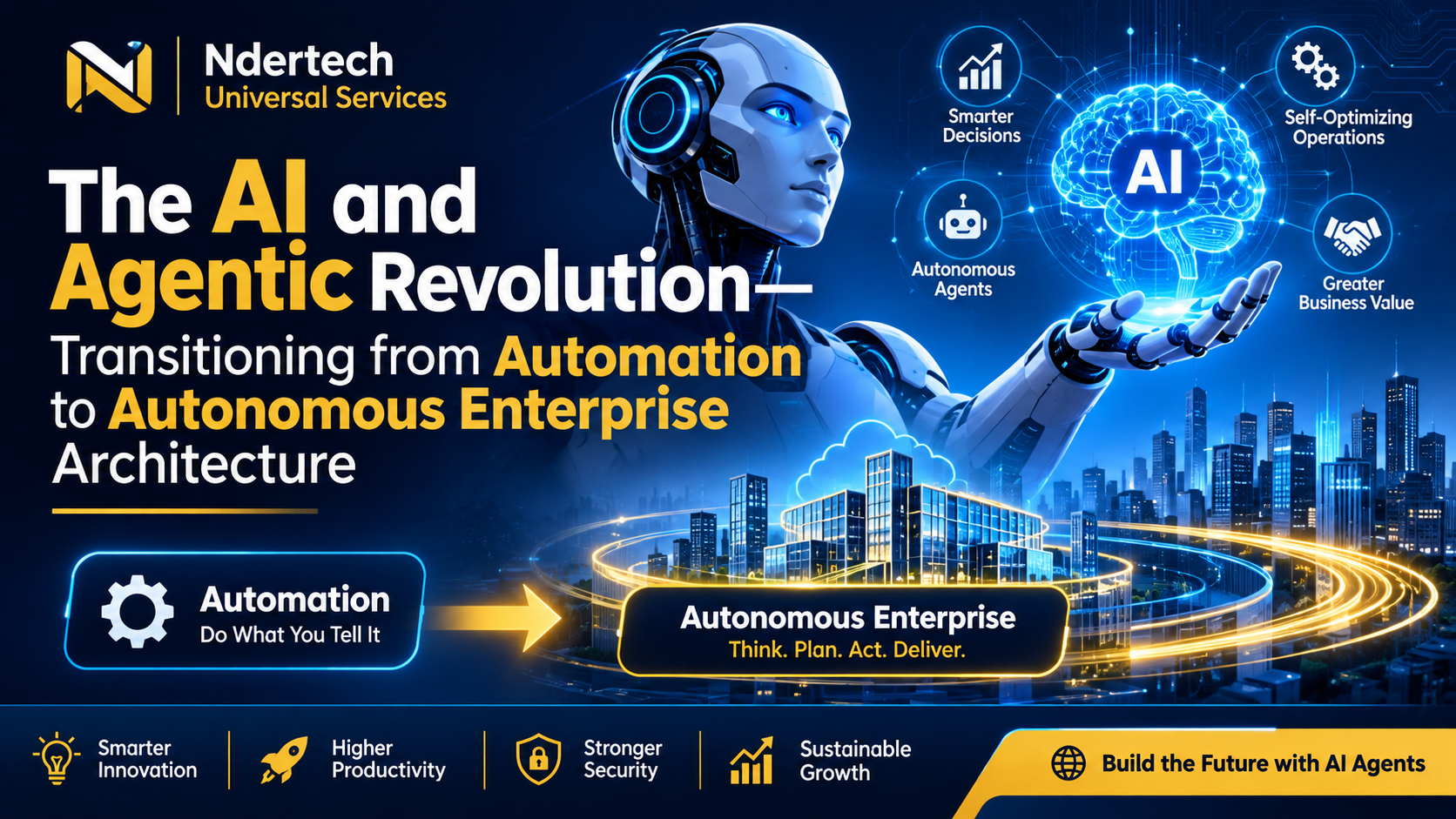
The AI and Agentic Revolution—Transitioning from Automation to Autonomous Enterprise Architecture
Introduction: The Paradigm Shift in Modern Enterprise IT
The information technology landscape is currently undergoing its most profound structural transformation since the commercialization of the internet. Artificial intelligence (AI), having rapidly evolved from a novel experimental toolkit into core enterprise infrastructure, is completely redefining how modern organizations approach operational workflows, system engineering, and enterprise architecture. Over the past year, the core discussion within boardrooms and technical committees has shifted dramatically. Organizations are no longer asking whether they should integrate artificial intelligence into their operations; instead, they are actively navigating the intricate operational realities of scaling multi-agent systems, managing high-stakes inference economics, and transitioning from rudimentary software automation to truly autonomous, agentic enterprise architectures.
As enterprises pilot and deploy advanced cognitive tools across departments, the traditional boundary between software execution and human oversight is becoming increasingly fluid. Yet, this wave of digital reinvention is not without significant friction. Industry reports from leading technology research firms consistently indicate that while a vast majority of organizations are actively experimenting with generative AI and multi-agent workflows, a notable portion encounter operational roadblocks. Interestingly, these roadblocks rarely stem from flaws in the underlying technology itself; rather, they occur because organizations historically attempt to automate broken, legacy processes rather than fundamentally redesigning their core business operations from the ground up. To capture the full economic value of modern AI, leaders must embrace comprehensive process re-engineering alongside technological adoption.
The Evolution from Rule-Based Scripts to Autonomous Agentic Workflows
For decades, enterprise automation was synonymous with rigid, deterministic software scripts and robotic process automation (RPA) tools designed to handle repetitive, low-variance administrative tasks such as data entry, simple form validation, and basic record routing. These legacy systems operated strictly within predefined parameters and lacked contextual awareness, rendering them fragile when confronted with unexpected variables or unstructured inputs.
Today, the introduction of agentic AI workflows has completely shattered this paradigm. Autonomous agents are capable of perceiving complex operational context, reasoning through multi-step problem-solving scenarios, querying external databases, invoking application programming interfaces (APIs), and dynamically self-correcting with minimal human intervention. This shift introduces an entirely new class of digital labor—often referred to as a silicon-based workforce.
Consider the transformation across various industry sectors:
- Supply Chain and Logistics: Enterprises are deploying integrated orchestration systems where fleet-management AI coordinates thousands of autonomous mobile robots and delivery vehicles in real time, dynamically rerouting shipments around weather anomalies and port congestion to drastically reduce transit times within fulfillment networks.
- Software Engineering: Engineering organizations utilize specialized coding agents capable of managing everything from automated bug identification, root-cause analysis, and regression testing to comprehensive documentation generation and incremental code refactoring.
- Customer Experience and Operations: Advanced cognitive agents handle complex, multi-turn customer resolutions, accessing secure enterprise databases to resolve billing discrepancies or technical support inquiries autonomously without immediate human escalation.
However, scaling these capabilities from isolated sandbox environments into mission-critical production requires navigating the "agentic reality check." Successful integration demands a rigorous rethinking of organizational processes. Leaders who simply layer advanced AI models over inefficient legacy workflows often find themselves scaling operational errors at unprecedented speeds. The winning enterprise strategy relies on intentional process redesign, ensuring that human experts act as strategic directors and governors while autonomous agents handle granular execution tasks.
The Infrastructure Reckoning: Inference Economics, Cloud Repatriation, and Hybrid Strategies
The explosive growth of generative models, large language frameworks, and autonomous agent deployments has triggered a massive infrastructure reckoning across the global IT industry. While the marginal cost of computing individual tokens has dropped exponentially over recent years, the sheer aggregate volume of organizational usage has skyrocketed. Consequently, many enterprise technology leaders have experienced severe cloud budget overruns, with monthly infrastructure and compute bills reaching unprecedented financial figures.
This surge in computational demand has forced a fundamental re-evaluation of data center design and enterprise cloud strategies. For over a decade, the default industry mantra was "cloud-first," with organizations migrating virtually all workloads to centralized public hyperscalers. Today, enterprises are rapidly transitioning toward a sophisticated hybrid and multi-cloud paradigm designed to optimize both performance and cost:
- Public Cloud for Elasticity and Bursting: Utilizing hyperscale infrastructure for dynamic workloads, burst training requirements, and globally distributed user access where scalability is paramount.
- On-Premises and Colocation for Inference Consistency: Bringing high-intensity, predictable AI inference workloads back to private data center infrastructure to control skyrocketing operational expenditures and maintain strict predictability.
- Edge Computing for Real-Time Immediacy: Processing real-time data closer to the physical source—such as factory floors, retail storefronts, and IoT endpoints—to minimize network latency and reduce bandwidth consumption.
Furthermore, a growing trend known as *geopatriation* has emerged across regulated industries. Organizations are actively migrating sensitive workloads and proprietary data repositories back within national borders or controlled local data centers to comply with increasingly stringent data sovereignty regulations, mitigate geopolitical supply chain risks, and protect intellectual property from cross-border vulnerabilities.
AI Governance, Security, and the Human Element in the Enterprise
As artificial intelligence permeates every layer of the enterprise technology stack, security and governance have transformed from backend administrative concerns into board-level strategic priorities. The proliferation of specialized, domain-specific models trained on sensitive internal enterprise data creates massive new attack surfaces. Modern enterprises now face highly sophisticated threats ranging from adversarial prompt injections and model poisoning to accidental data leakage via unauthorized shadow AI tools utilized by employees.
To counter these vulnerabilities effectively, forward-thinking organizations are establishing comprehensive AI governance frameworks. These governance protocols typically encompass:
- Dynamic Acceptable Use Policies: Regularly updated guidelines that keep pace with rapidly evolving generative capabilities and guard against regulatory compliance violations.
- AI Centers of Excellence (CoE): Cross-functional governance teams comprising legal, cybersecurity, engineering, and business unit leaders designed to evaluate emerging AI use cases and monitor ethical deployment.
- Rigorous Human-in-the-Loop Mandates: Ensuring that critical automated outputs—especially those impacting financial transactions, customer data privacy, and healthcare diagnostics—undergo mandatory human validation before execution.
Concurrently, the rapid technological transformation of the IT workforce is compelling organizations to rethink talent acquisition, training, and retention strategies. While routine coding, basic data entry, and Tier-1 IT support roles face significant displacement, demand for specialized technical skills has reached an all-time high. Professionals fluent in AI orchestration, machine learning operations (MLOps), lattice-based cryptography, and advanced data engineering are commanding premium career opportunities.
At the same time, uniquely human attributes—such as emotional intelligence, cross-functional leadership, ethical reasoning, and high-level strategic vision—are increasingly recognized as irreplaceable assets that no automated prompt or model can replicate. As the industry matures, the organizations that thrive will be those that successfully harmonize advanced silicon capability with human ingenuity, establishing a resilient, secure, and future-proof enterprise ecosystem.